
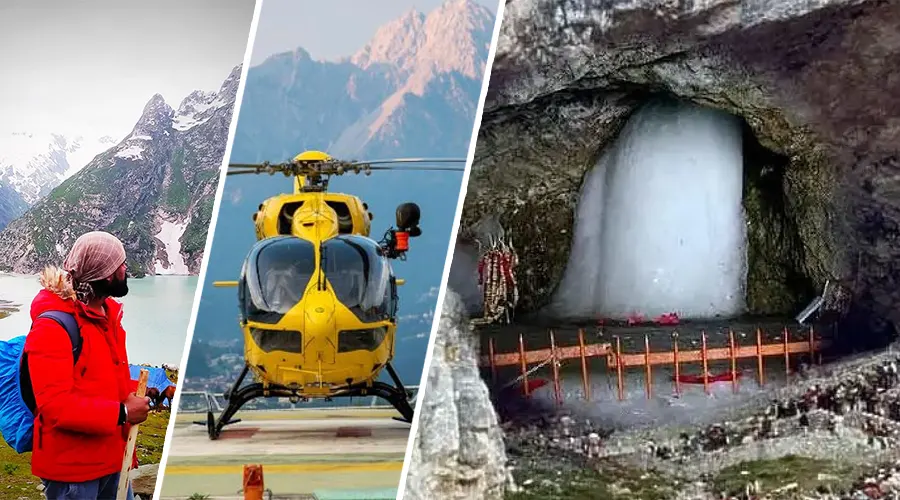
Amarnath Yatra 2026: Complete Travel, Registration, Route, Helicopter Booking, Dates & Tips
The Amarnath Yatra is one of India's most sacred Hindu pilgrimages, attracting millions of devotees every year to the holy Amarnath Cave in the Himalayas of Jammu & Kashmir. Located at an altitude of 3,888 metres (12,756 feet), the cave is famous for the naturally formed Ice Shivling, believed to represent Lord Shiva.
Every year, the pilgrimage is organized for a limited period during the summer when weather conditions make the Himalayan routes accessible. Pilgrims can choose between the traditional Pahalgam Route or the shorter Baltal Route, depending on their fitness level and travel plans.
If you're planning the Amarnath Yatra 2026, this guide covers everything you need, from official registration and required documents to route comparison, helicopter booking, accommodation, travel costs, packing tips, and safety guidelines. Whether you are a first-time visitor or a returning pilgrim, this comprehensive guide will help you prepare for a safe, comfortable, and spiritually fulfilling journey.
Amarnath Yatra 2026 Highlights
|
Details |
Information |
|
Yatra Dates |
3 July – 28 August 2026 |
|
Duration |
57 Days |
|
Registration Starts |
15 April 2026 |
|
Registration Fee |
₹150 per pilgrim |
|
Holy Cave Elevation |
3,888 metres |
|
Highest Point |
Mahagunas Pass – 4,276 metres |
|
Main Routes |
Baltal & Pahalgam |
|
Nearest Airport |
Srinagar International Airport |
|
Nearest Railway Station |
Jammu Tawi |
|
Trek Difficulty |
Moderate to Difficult |
|
Age Limit |
13–70 Years |
|
Official Website |
jksasb.nic.in |
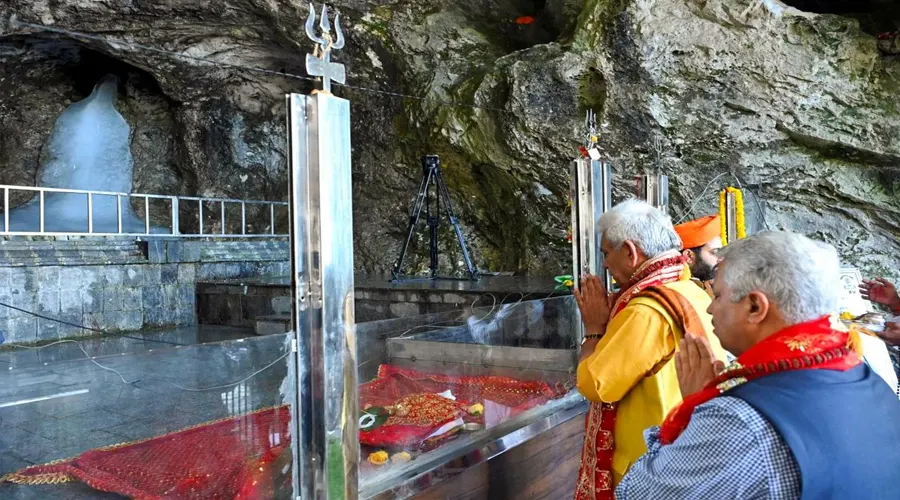
What is Amarnath Yatra?
The Amarnath Yatra is among the most significant pilgrimages in Hinduism and is dedicated to Lord Shiva. The journey leads devotees to the sacred Amarnath Cave, where a naturally formed Ice Shivling appears every year due to the freezing of water droplets inside the cave.
According to Hindu beliefs, this cave is where Lord Shiva revealed the secret of immortality (Amar Katha) to Goddess Parvati. To ensure complete secrecy, Lord Shiva is believed to have left behind Nandi, the moon, snakes, Lord Ganesha, and even the five elements before entering the cave.
Today, the pilgrimage is not only a religious event but also an extraordinary adventure through the breathtaking Himalayan landscapes of Kashmir. Snow-covered mountains, alpine meadows, glaciers, waterfalls, and crystal-clear streams make the journey spiritually enriching as well as visually spectacular.
The Yatra is managed every year by the Shri Amarnathji Shrine Board (SASB) in coordination with the Government of Jammu & Kashmir and Indian security forces to ensure the safety and smooth movement of pilgrims.
Amarnath Yatra 2026 Dates & Duration
The Amarnath Yatra 2026 will begin on 3 July 2026 and conclude on 28 August 2026, spanning a total of 57 days. The pilgrimage traditionally ends on Raksha Bandhan, when the sacred Chhari Mubarak reaches the holy cave.
Before the official opening of the pilgrimage, the Pratham Puja is scheduled to take place on 29 June 2026, marking the ceremonial beginning of the Yatra season.
Since the pilgrimage is conducted for only a limited period each year, pilgrims are advised to complete their registration and travel planning well in advance. Peak crowds are usually witnessed during July, weekends, and auspicious Hindu festivals.
Important Dates
Event | Date |
Registration Opens | 15 April 2026 |
Pratham Puja | 29 June 2026 |
Yatra Begins | 3 July 2026 |
Yatra Ends | 28 August 2026 |
Duration | 57 Days |
Latest Updates for Amarnath Yatra 2026
The Shri Amarnathji Shrine Board has announced several important guidelines for the 2026 pilgrimage to improve safety, crowd management, and the overall pilgrimage experience.
Some of the key updates include:
- Online and offline registration is mandatory for every pilgrim.
- A valid Compulsory Health Certificate (CHC) is required before registration.
- Every registered pilgrim must carry an RFID Card during the journey.
- Daily pilgrim limits will be monitored to reduce overcrowding.
- Enhanced medical camps and emergency rescue services will be available along both trekking routes.
- Security arrangements have been strengthened with surveillance systems, checkpoints, and disaster management teams.
- Helicopter services will continue from Baltal and Pahalgam sectors, subject to weather conditions.
Pilgrims are advised to regularly check official notifications before beginning their journey, as weather conditions in the Himalayas can lead to temporary route closures or travel advisories.
Why Visit Amarnath?
The Amarnath Yatra is much more than a mountain trek, it is a journey of faith, devotion, and self-discovery. Every step through the Himalayan valleys brings pilgrims closer to one of the holiest shrines dedicated to Lord Shiva.
Apart from its spiritual importance, the pilgrimage offers breathtaking natural beauty, including glaciers, alpine lakes, lush valleys, and snow-covered peaks. The warm hospitality of local communities, the chanting of "Har Har Mahadev" along the trail, and the shared devotion among thousands of pilgrims create a truly unforgettable experience.
Whether you seek spiritual peace, adventure, or a deeper connection with nature, the Amarnath Yatra offers an experience unlike any other pilgrimage in India.
Amarnath Yatra 2026 Registration: Step-by-Step Guide
Every pilgrim planning to undertake the Amarnath Yatra 2026 must complete the official registration process before beginning the journey. The Shri Amarnathji Shrine Board (SASB) has made registration mandatory to ensure the safety and proper management of pilgrims during the Yatra.

Registration for Amarnath Yatra 2026 started on 15 April 2026 and can be completed through both online and offline modes. Pilgrims must also obtain a Compulsory Health Certificate (CHC) and an RFID Card, both of which are essential for entering the pilgrimage routes.
How to Register for Amarnath Yatra 2026 Online
Online registration is the fastest and most convenient method for pilgrims.
Step 1: Visit the Official Website
Go to the official Shri Amarnathji Shrine Board website.
Step 2: Create an Account
Register using your mobile number and email ID.
Step 3: Fill in Personal Details
Enter:
- Full Name
- Date of Birth
- Address
- Mobile Number
- Aadhaar or other valid ID
- Emergency Contact Details
Step 4: Upload Required Documents
Upload clear scanned copies of:
- Passport-size photograph
- Government-issued Photo ID
- Compulsory Health Certificate (CHC)
Step 5: Select Route & Date
Choose your preferred pilgrimage route:
- Baltal Route
- Pahalgam Route
Then select your preferred Yatra date based on availability.
Step 6: Pay Registration Fee
Pay the registration fee online.
Registration Fee: ₹150 per pilgrim
Step 7: Download Yatra Permit
After successful payment and verification, download and print your Yatra Permit. Carry multiple copies during your journey.
Offline Registration Process
Pilgrims who prefer offline registration can visit any designated bank branch authorized by the Shri Amarnathji Shrine Board.
The major participating banks include:
- Jammu & Kashmir Bank
- Punjab National Bank (PNB)
- State Bank of India (SBI)
- YES Bank
Carry all required documents, complete the registration form, pay the registration fee, and collect your Yatra Permit.
Documents Required for Amarnath Yatra Registration
Before registering, keep the following documents ready:
|
Document |
Mandatory |
|
Aadhaar Card or Government Photo ID |
Yes |
|
Passport-size Photograph |
Yes |
|
Compulsory Health Certificate (CHC) |
Yes |
|
Mobile Number |
Yes |
|
Email Address |
Yes |
Make sure all uploaded documents are clear and match the information provided during registration.
Compulsory Health Certificate (CHC)
The Amarnath Cave is located at a very high altitude where oxygen levels are significantly lower than in the plains. To ensure the safety of pilgrims, obtaining a Compulsory Health Certificate (CHC) is mandatory.
The certificate confirms that the pilgrim is medically fit to undertake the demanding trek through the Himalayan terrain.
Important Guidelines
- CHC must be issued by an authorized doctor or approved medical institution.
- The certificate should be issued after 8 April 2026.
- It must include the pilgrim's recent photograph.
- Carry the original certificate throughout the Yatra.
Without a valid CHC, registration will not be accepted.
RFID Card – Mandatory for Every Pilgrim
The Shri Amarnathji Shrine Board has made RFID (Radio Frequency Identification) Cards compulsory for all registered pilgrims.
The RFID card helps authorities monitor the movement of pilgrims in real time, enhancing safety and emergency response during the Yatra.
Key Points
- Issued after registration and biometric verification.
- Must be worn around the neck throughout the pilgrimage.
- Required at all security checkpoints.
- Mandatory for both Baltal and Pahalgam routes.
- Lost RFID cards should be reported immediately.
Pilgrims without a valid RFID card will not be allowed to proceed beyond the entry checkpoints.
Who Can Register for Amarnath Yatra 2026?
To ensure safety, the Shrine Board has established eligibility criteria for pilgrims.
Eligible Pilgrims
- Indian Citizens
- NRIs (subject to guidelines)
- Age between 13 and 70 years
- Medically fit individuals
Not Eligible
- Children below 13 years
- Senior citizens above 70 years
- Pregnant women beyond six weeks
- Individuals with serious heart, respiratory, or high-altitude-related medical conditions
Medical fitness should always be prioritized before planning the pilgrimage.
Important Registration Tips
To avoid last-minute issues, follow these recommendations:
- Register as early as possible.
- Book your preferred Yatra date in advance.
- Keep digital and printed copies of all documents.
- Carry multiple passport-size photographs.
- Double-check the information entered during registration.
- Save emergency contact numbers on your phone.
- Purchase travel insurance if available.
- Reach the base camp one day before your scheduled trek.
Common Registration Mistakes to Avoid
Many pilgrims face delays due to simple errors during registration. Avoid the following:
- Uploading blurred or incomplete documents.
- Using an expired or invalid Health Certificate.
- Choosing the wrong Yatra date.
- Forgetting to print the permit.
- Carrying mismatched ID proof.
- Ignoring weather advisories.
- Arriving late at the reporting center.
Careful preparation will help ensure a smooth and hassle-free pilgrimage.
Quick Registration Checklist
- Register online or offline
- Obtain a Compulsory Health Certificate (CHC)
- Download and print the Yatra Permit
- Collect your RFID Card
- Carry original ID proof
- Keep emergency contacts handy
- Book accommodation in advance
- Prepare for high-altitude trekking
With your registration complete, the next step is choosing the most suitable trekking route. In the following section, we'll compare the Baltal Route and the traditional Pahalgam Route, including distance, difficulty, travel time, scenery, and which option is best for different types of pilgrims.
Baltal vs Pahalgam Route: Which Amarnath Yatra Route is Better?
One of the most important decisions while planning the Amarnath Yatra 2026 is choosing the right trekking route. Pilgrims can reach the holy cave through two officially approved routes, the Baltal Route and the Traditional Pahalgam Route.

Both routes lead to the sacred Amarnath Cave, but they differ significantly in terms of distance, trekking difficulty, scenery, duration, and overall experience. Choosing the right route depends on your physical fitness, available time, age, and travel preferences.
Baltal Route
The Baltal Route is the shortest and fastest way to reach the Amarnath Cave. Starting from Baltal Base Camp near Sonamarg, this route covers approximately 14 km (one way). Because of its shorter distance, many physically fit pilgrims complete the trek and return to Baltal on the same day.
However, despite being shorter, this trail is considerably steeper and more physically demanding. The climb involves narrow mountain paths, rocky terrain, and continuous ascents, making it suitable for experienced trekkers or pilgrims with good stamina.
Baltal Route Highlights
- Distance: Approximately 14 km (One Way)
- Trek Duration: 1–2 Days
- Difficulty Level: Difficult
- Best For: Fit pilgrims and those with limited time
- Base Camp: Baltal
- Nearby Town: Sonamarg
Major Stops
- Baltal
- Domail
- Barari
- Sangam
- Holy Amarnath Cave
Advantages
- Shortest trekking route.
- Ideal for weekend pilgrims.
- Helicopter services available.
- Suitable for experienced trekkers.
- Faster completion of the pilgrimage.
Challenges
- Very steep climb.
- Requires good physical fitness.
- More demanding on knees and joints.
- Weather changes rapidly.
Pahalgam Route
The Pahalgam Route is the traditional pilgrimage path followed for centuries. It offers a gradual climb through some of Kashmir's most breathtaking landscapes, including alpine meadows, glaciers, rivers, and mountain lakes.
Although much longer, around 46 to 48 km, this route is considered easier because the ascent is spread over several days. Most pilgrims complete this trek in 4 to 5 days, making it ideal for families, senior pilgrims (within the age limit), and first-time visitors.
Pahalgam Route Highlights
- Distance: 46 - 48 km
- Trek Duration: 3 - 5 Days
- Difficulty Level: Moderate
- Best For: Families and first-time pilgrims
- Base Camp: Pahalgam
Major Stops
- Pahalgam
- Chandanwari
- Pissu Top
- Sheshnag
- Mahagunas Pass
- Panchtarni
- Sangam
- Holy Cave
Advantages
- Traditional pilgrimage route.
- Less steep and more comfortable.
- Better acclimatization to high altitude.
- Beautiful Himalayan scenery.
- More accommodation and medical camps.
Challenges
- Longer trekking distance.
- Requires additional travel days.
- Slightly higher travel expenses.
Baltal vs Pahalgam Route Comparison
Feature | Baltal Route | Pahalgam Route |
Distance | 14 km | 46 - 48 km |
Trek Duration | 1–2 Days | 3 - 5 Days |
Difficulty | Difficult | Moderate |
Climb | Steep | Gradual |
Best For | Fit Pilgrims | Families & Beginners |
Scenic Beauty | Good | Excellent |
Accommodation | Limited | Better Facilities |
Helicopter Available | Yes | Yes |
Elevation Profile of the Traditional Route
Understanding the altitude helps pilgrims prepare for changing weather conditions and reduced oxygen levels.
Location | Elevation |
Pahalgam | 2,130 metres |
Chandanwari | 2,896 metres |
Sheshnag | 3,576 metres |
Mahagunas Pass | 4,276 metres |
Panchtarni | 3,657 metres |
Holy Cave | 3,888 metres |
Mahagunas Pass is the highest point of the entire pilgrimage and is even higher than the Amarnath Cave itself.
Which Route Should You Choose?
Your route selection should depend on your health, fitness level, available time, and travel preferences.
Choose Baltal Route If:
- You have only 2 - 3 days.
- You are physically fit.
- You prefer a shorter trek.
- You plan to use helicopter services.
- You have previous trekking experience.
Choose Pahalgam Route If:
- You are visiting Amarnath for the first time.
- You want the traditional pilgrimage experience.
- You enjoy scenic trekking.
- You are traveling with family.
- You want better altitude acclimatization.
Pony, Palki & Porter Services
Pilgrims who cannot complete the trek on foot can hire support services available along both routes.
Pony
Suitable for elderly pilgrims and those with limited mobility.
Palki (Palanquin)
Ideal for senior citizens or pilgrims unable to walk long distances.
Porter Services
Porters can carry luggage, allowing pilgrims to trek comfortably with minimal weight.
Charges for these services vary depending on the route and distance and are regulated by local authorities.
Trekking Tips for a Safe Journey
To make your trek safer and more enjoyable, follow these practical tips:
- Start trekking early in the morning.
- Walk at a steady pace without rushing.
- Drink plenty of water to stay hydrated.
- Avoid alcohol and smoking during the journey.
- Wear waterproof trekking shoes with a strong grip.
- Carry rain gear, as weather can change suddenly.
- Keep energy bars, dry fruits, and glucose with you.
- Follow instructions issued by security personnel and Shrine Board officials.
- Do not litter, help preserve the fragile Himalayan environment.
- Take frequent breaks to avoid exhaustion and altitude sickness.
Amarnath Helicopter Booking 2026
Pilgrims who wish to reduce trekking distance can opt for helicopter services, one of the most convenient ways to reach near the holy cave. Helicopters operate between the base camps and Panchtarni, from where pilgrims must complete the remaining approximately 6 km on foot, by pony, or by palki.
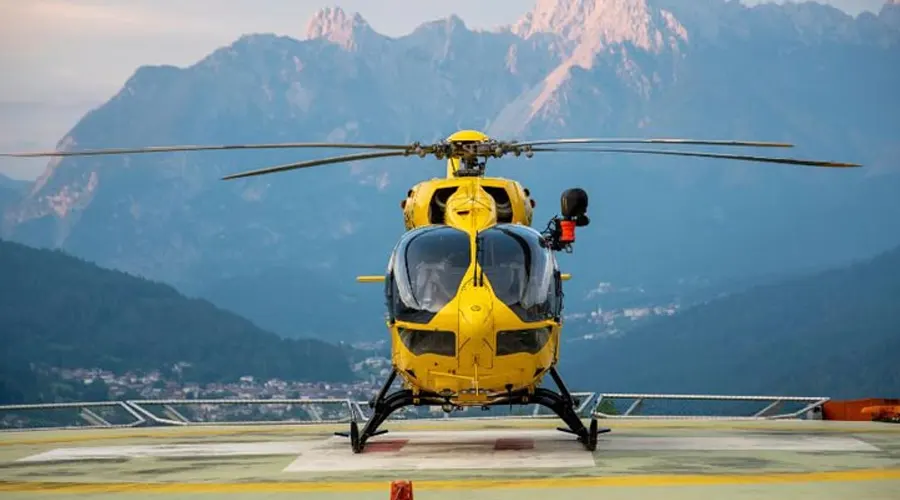
In the next section, we'll explain helicopter booking, fares, eligibility, booking process, travel rules, and how to reach the Amarnath base camps in detail.
Amarnath Helicopter Booking 2026
For pilgrims who want to reduce trekking time or avoid the physically demanding mountain trails, helicopter services are one of the most convenient travel options during the Amarnath Yatra 2026. Helicopter flights operate between the designated base camps and Panchtarni, which is the nearest landing point to the holy cave.
From Panchtarni, pilgrims still need to cover approximately 6 km to reach the Amarnath Cave. This final stretch can be completed on foot or by hiring a pony or palki service.
Helicopter tickets are limited and usually sell out quickly, especially during July and weekends. Therefore, it is advisable to book your tickets well in advance after completing your Yatra registration.
Amarnath Helicopter Route & Estimated Fare
|
Route |
Approximate Flight Time |
Estimated One-Way Fare* |
|
Baltal (Neelgrath) → Panchtarni |
8 - 10 Minutes |
₹3,000 - ₹3,500 |
|
Pahalgam → Panchtarni |
18 - 20 Minutes |
₹4,500 - ₹5,000 |
Note: Helicopter fares may vary each year. Always verify the latest prices and availability before booking.
How to Book Amarnath Helicopter Tickets
Booking a helicopter ticket is simple if you follow these steps:
Step 1
Complete your Amarnath Yatra registration and obtain your Yatra Permit.
Step 2
Visit the official helicopter booking portal authorized by the Shri Amarnathji Shrine Board.
Step 3
Select:
- Journey Date
- Departure Sector
- Number of Passengers
Step 4
Upload:
- Government Photo ID
- Yatra Registration Permit
Step 5
Complete the online payment.
Step 6
Download and print your helicopter ticket.
Carry both digital and printed copies while traveling.
Important Helicopter Guidelines
Before booking your helicopter tickets, keep these important points in mind:
- Yatra Registration is mandatory.
- Carry your original Photo ID.
- Reach the helipad at least 1 - 2 hours before departure.
- Flights depend entirely on weather conditions.
- Delays and cancellations are common due to heavy rain or poor visibility.
- Weight restrictions may apply.
- The final 6 km trek to the cave must still be completed after landing at Panchtarni.
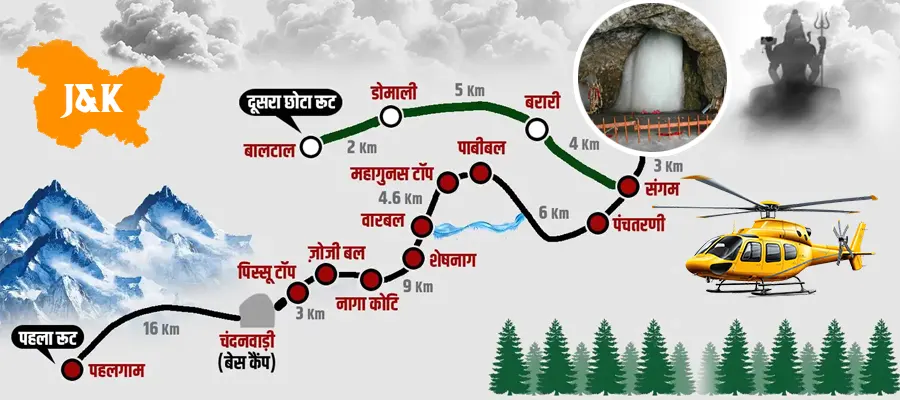
How to Reach Amarnath Yatra Base Camps
The holy cave is located in the Himalayas of Jammu & Kashmir and can be reached through Baltal or Pahalgam. Most pilgrims first arrive in Srinagar or Jammu, from where they travel by road to the respective base camps.
By Air
The nearest airport is Srinagar International Airport, which is well connected to major Indian cities such as Delhi, Mumbai, Bengaluru, Hyderabad, Kolkata, and Chandigarh.
Approximate road distances:
|
Destination |
Distance from Srinagar Airport |
|
Pahalgam |
90 km |
|
Baltal |
100 km |
|
Sonamarg |
80 km |
Taxis and shared cabs are easily available from the airport.
By Train
Although there is no railway station near the Amarnath Cave, pilgrims can travel by train to Jammu and continue by road.
Major railway stations include:
Railway Station | Approximate Distance |
Jammu Tawi | 300 km |
Udhampur | 210 km |
Banihal | 140 km |
Jammu Tawi remains the most preferred railway station due to its excellent connectivity with major cities.
By Road
Regular buses, taxis, and private vehicles operate between Jammu, Srinagar, Pahalgam, Sonamarg, and Baltal during the Yatra season.
Approximate travel distances:
Route | Distance |
Jammu → Srinagar | 270 km |
Srinagar → Pahalgam | 90 km |
Srinagar → Baltal | 100 km |
Baltal → Holy Cave | 14 km Trek |
Pahalgam → Holy Cave | 46 - 48 km Trek |
Road conditions may change due to rainfall or landslides, so always check the latest travel advisories before departure.
Best Time to Visit Amarnath
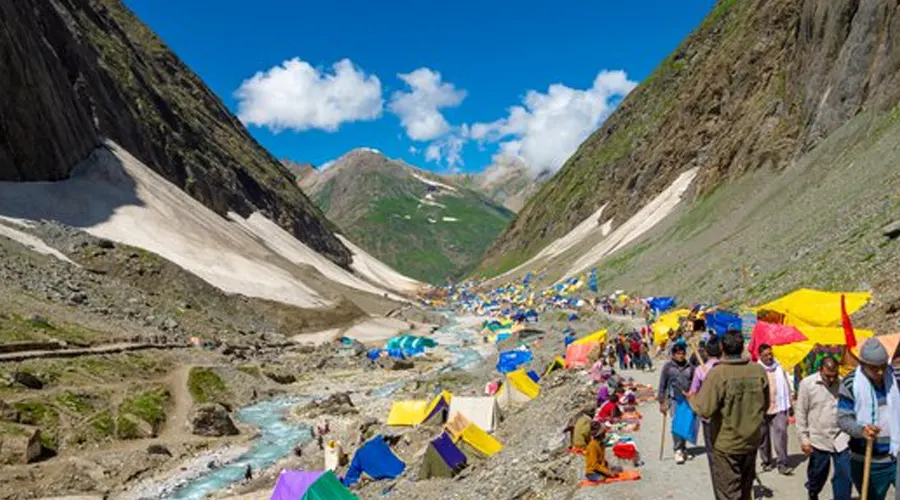
Although the Yatra remains open for 57 days, choosing the right time can significantly improve your experience.
Early July
Recommended for most pilgrims
Advantages:
- Pleasant weather
- Smaller crowds
- Better trekking conditions
- Ice Shivling is generally well-formed
Mid July
- Moderate crowd levels
- Comfortable temperatures
- Suitable for families
August
- Heavy pilgrim rush
- Higher chances of rainfall
- Slippery trekking routes
- Weather becomes more unpredictable
If possible, plan your visit during the first half of July for a smoother pilgrimage.
Weather During Amarnath Yatra
Mountain weather changes rapidly, even during summer.
|
Time |
Temperature |
|
Day |
10°C - 20°C |
|
Night |
0°C - 5°C |
|
Higher Altitude |
Below Freezing |
Pilgrims should be prepared for:
- Sudden rainfall
- Snowfall at higher elevations
- Strong mountain winds
- Cold nights
- Dense fog
Always carry warm clothing, even if the weather appears clear in Srinagar.
Packing Checklist
Packing wisely can make your pilgrimage safer and more comfortable.
Clothing
- Thermal innerwear
- Warm jacket
- Waterproof raincoat
- Woollen cap
- Gloves
- Extra socks
Footwear
- Waterproof trekking shoes
- Comfortable slippers for camps
Essentials
- Aadhaar Card
- Yatra Permit
- RFID Card
- Compulsory Health Certificate
- Mobile charger
- Power bank
- Torch
- Sunglasses
- Sunscreen
- Lip balm
- Water bottle
Medical Kit
Carry:
- Personal medicines
- Pain relief spray
- Bandages
- ORS packets
- Basic first-aid kit
- High-altitude medication (only after consulting your doctor)
Where to Stay During Amarnath Yatra
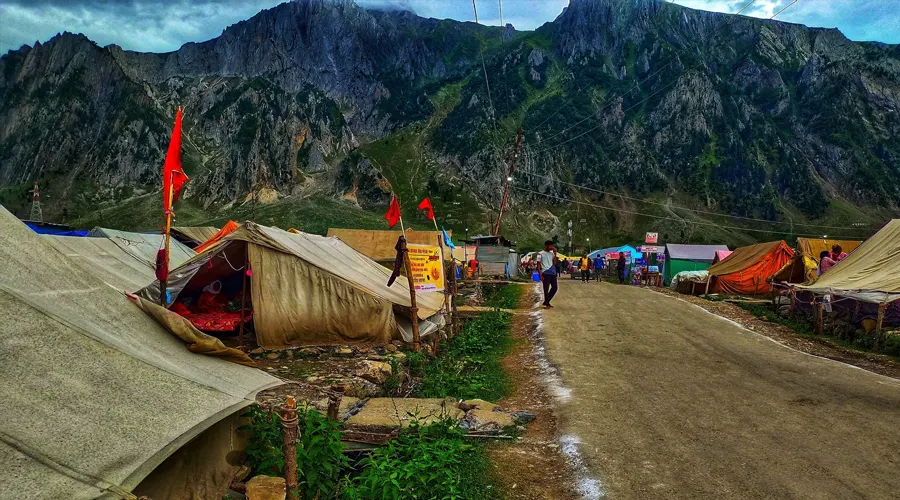
Accommodation options are available at various locations along the pilgrimage route. Pilgrims can choose hotels, guest houses, tents, or government camps depending on their budget and travel plan.
Srinagar
Ideal for:
- Pre-Yatra stay
- Family accommodation
- Luxury hotels
- Houseboats
- Budget guest houses
Pahalgam
Best for pilgrims choosing the traditional route.
Accommodation options include:
- Hotels
- Resorts
- Tourist lodges
- Tent camps
Baltal
Baltal mainly offers:
- Temporary tents
- Community camps
- Langar accommodation
- Basic facilities
Pilgrims usually stay here for one night before beginning the trek.
Accommodation Booking Tips
- Reserve hotels well in advance during peak season.
- Choose accommodation close to your departure point.
- Carry sufficient cash, as digital payments may not work in remote areas.
- Confirm check-in timings before arrival.
- Book refundable hotels whenever possible due to weather-related travel changes.
Suggested Amarnath Yatra Itinerary
Planning your itinerary in advance helps ensure a smooth and comfortable pilgrimage. The duration of your journey depends on the route you choose. Pilgrims opting for the Baltal Route can usually complete the Yatra in 2 -3 days, while those choosing the traditional Pahalgam Route should plan for 4 - 5 days.
2-Day Baltal Itinerary
Day 1: Arrival at Srinagar – Baltal
- Arrive at Srinagar Airport or Jammu.
- Travel to Baltal Base Camp (approximately 3 hours from Srinagar).
- Complete security verification and document checks.
- Collect your RFID Card if required.
- Stay overnight at Baltal camp or nearby accommodation.
- Rest well and prepare for the trek.
Day 2: Baltal – Holy Cave – Return
- Begin trekking before sunrise.
- Reach the Holy Cave for darshan.
- Spend some time at the shrine.
- Return to Baltal on the same day or via helicopter from Panchtarni (if booked).
- Continue your journey to Srinagar or stay overnight.
4-Day Traditional Pahalgam Itinerary
Day 1: Srinagar to Pahalgam
- Arrive in Srinagar.
- Drive to Pahalgam (approximately 90 km).
- Explore the local market.
- Stay overnight.
Day 2: Pahalgam – Chandanwari – Sheshnag
- Begin your trek from Chandanwari.
- Cross Pissu Top.
- Reach Sheshnag by evening.
- Overnight stay in camps.
Day 3: Sheshnag – Mahagunas Pass – Panchtarni – Holy Cave
- Start early in the morning.
- Cross Mahagunas Pass (4,276 m).
- Reach Panchtarni.
- Visit the Holy Cave for darshan.
- Return to Panchtarni for an overnight stay.
Day 4: Panchtarni – Pahalgam – Srinagar
- Descend towards Pahalgam.
- Drive back to Srinagar.
- Complete your pilgrimage.
Estimated Cost of Amarnath Yatra 2026
The total budget depends on your mode of travel, accommodation, and whether you choose trekking or helicopter services.
Expense | Estimated Cost (Per Person) |
Registration Fee | ₹150 |
Compulsory Health Certificate | ₹300 - ₹800 |
Srinagar to Base Camp Transport | ₹1,000 - ₹2,500 |
Budget Accommodation | ₹800 - ₹2,000 per night |
Hotel Stay | ₹2,500 - ₹6,000 per night |
Meals | ₹300 - ₹800 per day |
Pony/Palki (Optional) | ₹2,000 - ₹6,000 |
Helicopter (Optional) | ₹3,000 - ₹5,000 |
Miscellaneous Expenses | ₹1,000 - ₹2,000 |
Approximate Total Budget
|
Travel Style |
Estimated Budget |
|
Budget Pilgrim |
₹8,000 - ₹12,000 |
|
Standard Trip |
₹15,000 - ₹22,000 |
|
Helicopter Package |
₹20,000 - ₹35,000+ |
The above estimates exclude airfare or long-distance train travel and may vary depending on season and availability.
Health & Safety Tips
The Amarnath Yatra takes place in a high-altitude Himalayan region where weather conditions can change quickly. Proper preparation is essential for a safe pilgrimage.
Before Starting the Trek
- Consult your doctor if you have heart, lung, or blood pressure issues.
- Walk regularly for a few weeks before the Yatra to improve stamina.
- Pack light but carry all essential medicines.
- Get adequate sleep before your trek.
During the Trek
- Walk at a comfortable pace.
- Drink plenty of water to stay hydrated.
- Eat light and nutritious meals.
- Avoid alcohol and smoking.
- Take regular breaks to prevent exhaustion.
- Wear layered clothing to adapt to changing temperatures.
- Follow instructions issued by the Shrine Board and security personnel.
Symptoms of Altitude Sickness
Seek medical help immediately if you experience:
- Severe headache
- Difficulty breathing
- Persistent vomiting
- Dizziness
- Extreme fatigue
- Confusion or loss of balance
Do not ignore these symptoms, as they can become serious at high altitude.
Travel Tips for a Hassle-Free Pilgrimage
- Register early to secure your preferred Yatra date.
- Book accommodation and transport well in advance.
- Carry multiple photocopies of important documents.
- Keep cash for remote areas where digital payments may not work.
- Protect your phone and documents in waterproof bags.
- Start trekking early each morning to avoid afternoon weather changes.
- Respect local customs, traditions, and the natural environment.
- Avoid plastic waste and help keep the pilgrimage route clean.
The Amarnath Yatra 2026 is one of India's most sacred and spiritually enriching pilgrimages, combining unwavering faith with the breathtaking beauty of the Himalayas. Whether you choose the shorter Baltal Route or the traditional Pahalgam Route, careful planning is the key to a safe and memorable experience.
Complete your registration well in advance, obtain the required Compulsory Health Certificate, carry all essential documents, and stay updated with official Shrine Board advisories before your journey. Packing appropriately, maintaining physical fitness, and respecting the fragile Himalayan environment will help ensure a smooth pilgrimage.
With proper preparation and devotion, your visit to the holy Amarnath Cave can become a truly unforgettable spiritual journey. May Lord Shiva bless you with a safe, peaceful, and fulfilling Amarnath Yatra 2026.
Har Har Mahadev!
Faq About Amarnath Yatra 2026: Complete Travel, Registration, Route, Helicopter Booking, Dates & Tips
Ans: The Amarnath Yatra 2026 is scheduled to begin on 3 July 2026 and conclude on 28 August 2026, covering a total duration of 57 days. The pilgrimage traditionally ends on the auspicious occasion of Raksha Bandhan, when the sacred Chhari Mubarak reaches the Holy Cave. Pilgrims should complete their registration well in advance, as the number of daily visitors is regulated for safety and crowd management.
Ans: Pilgrims can register online through the official Shri Amarnathji Shrine Board (SASB) website or offline at designated bank branches across India. Registration requires a valid government-issued photo ID, a Compulsory Health Certificate (CHC), a passport-size photograph, and payment of the registration fee. After successful registration, pilgrims receive a Yatra Permit and must also obtain an RFID card before beginning the journey.
Ans: The choice depends on your fitness level and available time. The Baltal Route is only about 14 km and can often be completed within one or two days, making it ideal for physically fit pilgrims. The Pahalgam Route is around 46–48 km and takes 3–5 days, but it offers a gradual climb, better acclimatization, and scenic Himalayan landscapes. First-time visitors and families generally prefer the traditional Pahalgam Route.
Ans: Yes. Every pilgrim must obtain a Compulsory Health Certificate (CHC) issued by an authorized medical institution approved by the Shrine Board. The Amarnath Cave is situated at an altitude of 3,888 metres, where oxygen levels are lower than normal. The CHC confirms that a pilgrim is medically fit to undertake the high-altitude trek and is mandatory for completing the registration process.
Ans: Yes, helicopter services are available from Baltal (Neelgrath) and Pahalgam to Panchtarni, significantly reducing the trekking distance. However, pilgrims must still cover the final approximately 6 km from Panchtarni to the Holy Cave on foot, by pony, or by palki. Helicopter seats are limited and subject to weather conditions, so early booking is strongly recommended.
Ans: Although the pilgrimage remains open from July to August, the first half of July is generally considered the best time to visit. During this period, weather conditions are relatively stable, trekking routes are more comfortable, and the naturally formed Ice Shivling is often at its fullest. Pilgrims visiting in August should be prepared for heavier crowds and occasional rainfall.
Ans: Since the Yatra involves trekking through high-altitude Himalayan terrain, proper packing is essential. Carry warm layered clothing, a waterproof jacket, trekking shoes with a good grip, woollen gloves and cap, sunglasses, sunscreen, reusable water bottle, energy snacks, flashlight, power bank, personal medicines, first-aid kit, and all important documents such as your Yatra Permit, RFID Card, Health Certificate, and government-issued ID.
Ans: According to the Shri Amarnathji Shrine Board guidelines, only pilgrims between 13 and 70 years of age are eligible to participate in the Yatra. Pregnant women beyond six weeks are not permitted due to health and safety concerns. Every pilgrim must also meet the required medical fitness standards and possess a valid Compulsory Health Certificate before registration.
Ans: The overall cost depends on your travel style, accommodation, transportation, and whether you choose helicopter services. A budget pilgrimage may cost around ₹8,000–₹12,000 per person, while a comfortable trip with better accommodation may range between ₹15,000 and ₹22,000. Pilgrims opting for helicopter services should expect a higher overall budget, typically between ₹20,000 and ₹35,000 or more, excluding airfare.
Ans: Preparing your body before the pilgrimage is essential because of the steep climbs and high altitude. Begin walking or jogging daily at least 4–6 weeks before the Yatra, practice climbing stairs, and perform light cardio exercises to improve stamina. Eat a balanced diet, stay hydrated, avoid smoking and alcohol, and consult your doctor if you have any pre-existing medical conditions. Adequate physical preparation significantly improves your trekking experience and reduces the risk of altitude-related illnesses.
Comments (0)