
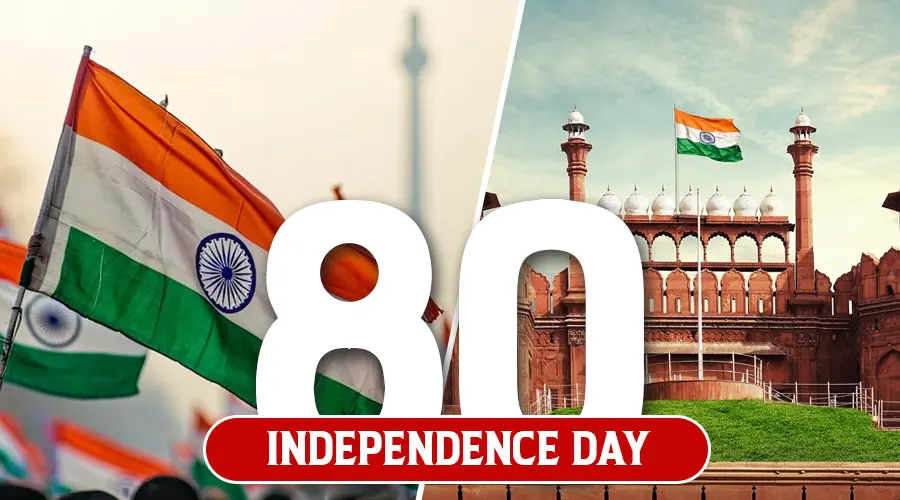
India’s 80th Independence Day 2026: 80 Years of Freedom, Heritage, Unity & the Spirit of India
India’s 80th Independence Day on 15 August 2026 will be a landmark occasion in the country's history. Eight decades after India gained independence, the day offers an opportunity to remember the sacrifices of the freedom movement, celebrate the country's remarkable journey and rediscover the heritage that makes India truly unique.
From the historic Red Fort in Delhi to the places where India's freedom movement unfolded, India's landscape is filled with stories of courage, sacrifice and resilience. Forts, memorials, museums, heritage cities and historic landmarks continue to preserve these memories for future generations.
For travellers, Independence Day offers a special way to look at India not simply as a collection of destinations, but as a living story of freedom, diversity, courage and resilience.
As India celebrates its 80th Independence Day in 2026, let's explore the history, traditions, landmarks and travel experiences that make this occasion so meaningful.
Why Is India’s Independence Day Celebrated on 15 August?
India gained independence from British rule on 15 August 1947 after decades of political movements, protests, revolutionary activities, social reform and sacrifices by people across the country.
The significance of Independence Day goes far beyond the end of colonial rule. It represents the aspirations of generations who dreamed of a free India and worked towards creating a nation capable of determining its own future.
Every year, 15 August provides an opportunity to remember those who contributed to India's freedom struggle and reflect on the responsibilities that come with independence.
In 2026, the occasion becomes especially significant as India celebrates 80 years of independence.
India’s 80th Independence Day 2026: Quick Facts
| Particular | Details |
|---|---|
| Occasion | India's 80th Independence Day |
| Date | 15 August 2026 |
| Independence Year | 1947 |
| First Independence Day | 15 August 1947 |
| Major Ceremony | Flag Hoisting & Prime Minister's Address |
| Main Venue | Red Fort, Delhi |
| National Symbol | Indian Tricolour |
| Historic Speech | “Tryst with Destiny” |
| Theme | Freedom, Unity, Heritage & National Pride |
| Best For | History, Heritage & Cultural Tourism |
India’s Journey from 1947 to 2026
India in 1947 was a young nation facing enormous challenges. The country had to establish democratic institutions, strengthen its economy, develop infrastructure and bring together a population with extraordinary linguistic, cultural and geographical diversity.
Over the following eight decades, India experienced remarkable transformation.
Cities expanded, roads and railways connected distant regions, education and technology developed rapidly, and Indian businesses reached global markets. India's achievements in areas such as science, space, medicine and technology have also gained international recognition.
Yet perhaps one of India's greatest achievements has been its ability to remain united while preserving its extraordinary diversity.
India Today: A Nation of Diversity
India is home to:
- Hundreds of languages and dialects
- Numerous religions and communities
- Diverse regional traditions
- Historic cities and heritage sites
- Himalayan landscapes and mountain valleys
- Deserts, forests, beaches and islands
- Traditional arts, crafts, music and cuisines
This diversity is one of the country's greatest strengths and an important part of India's identity.
Key Moments in India’s Independence Journey
India's freedom movement was shaped by numerous events and movements over several decades.
| Year | Important Event |
|---|---|
| 1857 | Revolt of 1857 |
| 1885 | Formation of the Indian National Congress |
| 1905 | Swadeshi Movement |
| 1919 | Jallianwala Bagh massacre |
| 1920–22 | Non-Cooperation Movement |
| 1930 | Dandi March and Civil Disobedience Movement |
| 1942 | Quit India Movement |
| 1947 | India gained independence on 15 August |
These events represent only some of the major milestones in India's long journey towards independence.
Remembering the Freedom Fighters of India
India's independence was not achieved by a single person or movement. It was the result of contributions from countless individuals and organisations across different parts of the country.
Mahatma Gandhi
Mahatma Gandhi became one of the most influential figures of India's freedom movement through his philosophy of non-violence, civil disobedience and mass mobilisation.
His leadership encouraged millions of Indians to participate in the struggle for independence.
Subhas Chandra Bose
Subhas Chandra Bose inspired thousands with his determination to achieve India's independence and his leadership of the Indian National Army (INA).
His legacy continues to inspire discussions about courage, sacrifice and patriotism.
Bhagat Singh
Bhagat Singh became an enduring symbol of revolutionary courage. His writings, ideas and sacrifice have continued to influence generations of Indians.
Sardar Vallabhbhai Patel
Sardar Vallabhbhai Patel played a crucial role in the political integration of India after independence. His efforts in bringing princely states into the Indian Union earned him the title of the Iron Man of India.
Jawaharlal Nehru
Jawaharlal Nehru, India's first Prime Minister, played an important role in the final phase of the independence movement and the early years of independent India.
His famous “Tryst with Destiny” speech marked India's transition into a new era.
The Unsung Heroes
Beyond famous leaders were millions of ordinary Indians students, farmers, workers, women, writers, activists and revolutionaries who participated in the freedom struggle in different ways.
Their stories remind us that history is not created only by famous personalities. It is also shaped by ordinary people who choose to stand for something greater than themselves.
The Midnight of 14–15 August 1947
One of the most memorable moments in India's history occurred around midnight on 14–15 August 1947.
As British rule came to an end, India began its journey as an independent nation. Jawaharlal Nehru delivered his historic “Tryst with Destiny” speech before the Constituent Assembly.
The moment represented both celebration and responsibility.
India had achieved freedom, but the enormous task of building a democratic and prosperous nation had only begun.
Eighty years later, that historic moment remains deeply embedded in India's collective memory.
The Indian Tricolour and Its Significance
The Indian national flag, popularly known as the Tricolour, is one of the most powerful symbols of India's national identity.
The present design of the flag was adopted by the Constituent Assembly on 22 July 1947, shortly before independence.
The flag consists of three horizontal bands:
- Saffron at the top
- White in the middle
- Green at the bottom
- Ashoka Chakra in navy blue at the centre
The Tricolour is closely associated with India's freedom struggle and democratic journey.
On Independence Day, the sight of the national flag flying across homes, schools, public buildings and historic monuments creates a strong sense of shared national pride.
Red Fort: The Heart of Independence Day Celebrations
Few monuments are as closely associated with India's Independence Day as the Red Fort in Delhi.
Every year on 15 August, the Prime Minister of India hoists the national flag at the Red Fort and addresses the nation. The tradition began with India's first Prime Minister, Jawaharlal Nehru, in 1947.
Today, the Red Fort remains one of India's most important symbols of independence.
For travellers visiting Delhi around Independence Day, the historic monument offers a powerful connection with the country's past. Its massive red sandstone walls are not merely an architectural attraction—they are part of India's living history.
Independence Day Celebrations Across India
Although the national ceremony is centred around Delhi, Independence Day is celebrated enthusiastically across the country.
Common celebrations include:
- Flag-hoisting ceremonies
- National anthem performances
- Patriotic cultural programmes
- School competitions
- Traditional dance and music performances
- Community gatherings
- Heritage and educational programmes
- Patriotic decorations
- Special events at public institutions
The celebration takes different forms in different parts of India.
This is one of the most beautiful aspects of Independence Day: the country celebrates its unity without losing its diversity.
Important Places Connected With India’s Freedom Struggle
India's freedom movement is closely connected with numerous historical sites. Visiting these places can help travellers understand the country's history beyond textbooks.
| Historical Place | Location | Why It Is Important |
|---|---|---|
| Red Fort | Delhi | Centre of the annual Independence Day ceremony |
| Raj Ghat | Delhi | Memorial dedicated to Mahatma Gandhi |
| Jallianwala Bagh | Amritsar | Important site connected with the 1919 massacre |
| Sabarmati Ashram | Ahmedabad | Closely associated with Mahatma Gandhi |
| Cellular Jail | Port Blair | Associated with imprisonment of freedom fighters |
| Aga Khan Palace | Pune | Important site connected with the Quit India Movement |
| Swaraj Bhawan | Prayagraj | Associated with the Nehru family and freedom movement |
| Mani Bhavan | Mumbai | Associated with Mahatma Gandhi's activities |
The Best Way to Celebrate Independence Day? Explore India
There is something uniquely meaningful about travelling through India during a national celebration.
Imagine watching the sunrise over the Himalayas, walking through the historic lanes of Delhi, exploring the forts of Rajasthan or experiencing the cultural traditions of Tamil Nadu.
You could also cruise through the backwaters of Kerala, stand beside the sea in Mumbai, explore the heritage streets of Kolkata, visit the islands of Andaman and Nicobar or discover the landscapes and communities of Northeast India.
Every destination tells a different story.
And together, those stories form India.
Independence Day and Indian Tourism
India's independence story is also a story of places.
Every state has its own historical landmarks, museums, forts, monuments, battlefields and cultural traditions.
Travelling to these places helps preserve their stories and keeps India's heritage alive.
When travellers visit historical monuments, learn about local traditions, support artisans and interact respectfully with communities, tourism becomes more than recreation.
It becomes a way of connecting with India's heritage.
How Tourism Can Support Heritage
Responsible tourism can help by:
- Supporting local artisans
- Buying authentic local handicrafts
- Choosing local businesses
- Respecting heritage-site rules
- Avoiding littering
- Protecting monuments from damage
- Learning about local history
- Respecting local traditions and communities
Independence Day Travel Experiences Across India
| Destination | Travel Experience |
|---|---|
| Delhi | Red Fort, Raj Ghat, museums and heritage walks |
| Amritsar | Jallianwala Bagh, Golden Temple and Partition Museum |
| Ahmedabad | Sabarmati Ashram and heritage attractions |
| Mumbai | Colonial architecture and freedom-era landmarks |
| Kolkata | Historic neighbourhoods and cultural heritage |
| Pune | Aga Khan Palace and historic attractions |
| Port Blair | Cellular Jail and freedom movement history |
| Prayagraj | Swaraj Bhawan and Nehru-era heritage |
| Rajasthan | Historic forts, palaces and Rajput heritage |
How to Celebrate Independence Day Responsibly
Independence Day celebrations can also be an opportunity to contribute positively to society and protect India's heritage.
Here are some meaningful ways to celebrate:
- Visit a historical monument or museum.
- Learn about India's freedom movement.
- Explore the history of your own city or state.
- Support local artisans and handicraft sellers.
- Keep heritage sites clean.
- Follow monument rules and visitor guidelines.
- Avoid damaging walls, structures or historic objects.
- Choose responsible and sustainable travel.
- Introduce children to India's history and heritage.
- Share reliable historical information.
- Respect India's cultural and regional diversity.
What Does Freedom Mean Today?
For the generation that experienced independence, freedom meant liberation from colonial rule.
For later generations, freedom has taken on new dimensions.
It can mean:
- The freedom to dream
- The freedom to learn
- The freedom to travel
- The freedom to build a career
- The freedom to express oneself
- The freedom to explore different cultures and ideas
- The freedom to participate in the country's democratic process
But freedom also comes with responsibility.
It is our responsibility to respect others, protect the environment, preserve heritage, value diversity and contribute positively to society.
The true meaning of independence lies not only in remembering how freedom was achieved, but also in understanding how it can be protected and strengthened.
At ExploreOurIndia.com, we believe that travelling through India is one of the best ways to understand its incredible diversity.
From historical monuments and heritage cities to breathtaking landscapes, local traditions and hidden destinations, there is always another Indian story waiting to be discovered.
Explore India. Experience India. Discover its story.
Jai Hind!
Faq About India’s 80th Independence Day 2026: 80 Years of Freedom, Heritage, Unity & the Spirit of India
Ans: India’s 80th Independence Day will be celebrated on 15 August 2026. The day marks 79 years since India became independent from British rule in 1947.
Ans: India became independent from British rule on 15 August 1947. Since then, 15 August has been observed every year as India's Independence Day.
Ans: The main national Independence Day ceremony is held at the Red Fort in Delhi, where the Prime Minister hoists the national flag and addresses the nation.
Ans: India’s 80th Independence Day in 2026 is a significant milestone that provides an opportunity to reflect on the country's journey since independence and celebrate its achievements, diversity and heritage.
Ans: Jawaharlal Nehru, India's first Prime Minister, delivered the historic “Tryst with Destiny” speech around midnight on 14–15 August 1947.
Ans: The present design of the Indian national flag was adopted by the Constituent Assembly on 22 July 1947, shortly before India became independent.
Ans: Popular historical destinations include Red Fort, Raj Ghat, Jallianwala Bagh, Sabarmati Ashram, Cellular Jail, Aga Khan Palace and Swaraj Bhawan.
Ans: Independence Day is celebrated with flag-hoisting ceremonies, cultural programmes, patriotic performances, school events, community gatherings and national celebrations across the country.
Ans: Delhi, Amritsar, Ahmedabad, Mumbai, Pune, Prayagraj and Port Blair are among the important destinations for exploring India's freedom movement and historical heritage.
Ans: Travellers can visit heritage sites, learn about local history, support local artisans, follow monument rules, avoid littering and respect local communities and cultural traditions.
Comments (0)